

What Type Cement To Repair Corner Of Porch
Q&A /
Porch Settling Repair
DEAR TIM: We're having a problem with the front porch on our dwelling house that'due south forty-four years old. The outside corner of the poured concrete porch is curving upwards lifting the post that'southward supporting the roof. In that location'southward no tree or roots that could be to blame. The brickwork under the porch that connects back to the firm looks fine with no cracks. Gravity should be pulling the physical downwards, not going up in the air. Every contractor we have talked with is clueless. What is going on? How did this happen? How could it have been prevented and how exercise nosotros repair it? Sami B., Toledo, OH
DEAR SAMI: I'm sorry yous're having this problem and it's a shame you can't locate a knowledgeable contractor to tell you what's going on. I was able to determine the crusade of your problem in seconds later on looking at the splendid photo you provided.
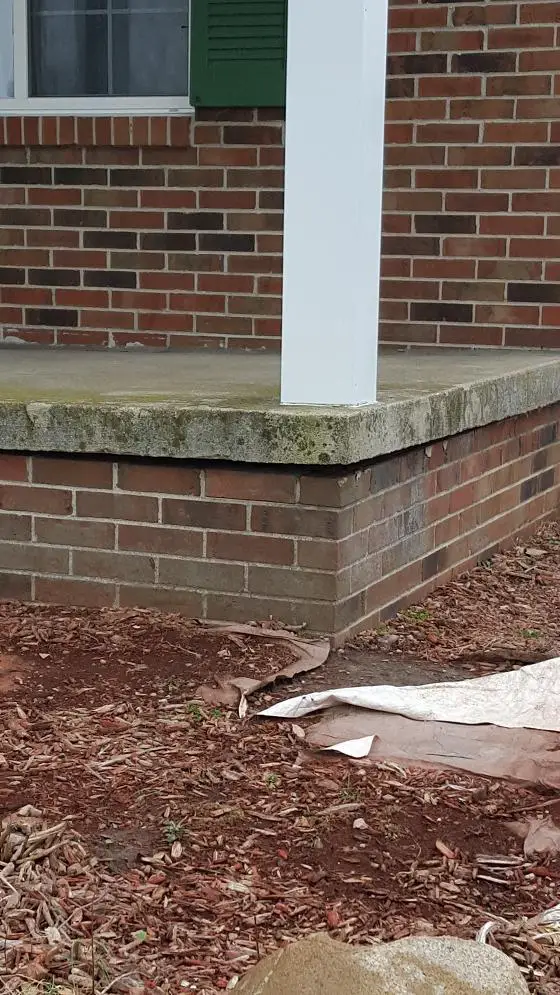
You have to look very closely at this photo for the inkling as to what's happening with this porch slab. Photo Credit: Sami Boraby
You're then correct about gravity's pull, and that's exactly what's in play hither. What you didn't think to add to it is what you lot discovered in high school physics class nigh a unproblematic first course lever. These are but like a teeter-totter you encounter in a play ground that kids get upward and down on.
Your front porch slab probably has some reinforcing steel bars in information technology and this monolithic slab is interim every bit a giant lever. The low brick wall nether the slab is the fulcrum. Gravity is the load that's causing the slab to motility up under the roof-support post.
I was able to tell all of this looking at the photo. You tin see clearly that the back of the slab where information technology touched the forepart wall of the house has dropped. The edge of the slab is no longer parallel with the brick mortar joint and you can see small amounts of physical from the slab that got splashed up onto the brick all those years agone when the house was built.
In a nutshell, the ground nether the concrete porch has settled. My guess is if we had x-ray vision, we'd encounter that the builder but put some of the soil that was dug out of the ground to install the foundation back nether the porch. The trouble with this exercise is that the soil gets fluffed upward when you dig it. The digging activity introduces all sorts of air into the soil and it's volume increases.
Information technology'south not easy to compact soil. There are special machines that can exist used to practice it and on a pocket-size scale it's labor intensive. Information technology's very mutual for sub-standard builders to cut corners like this.
Information technology could have been prevented in several ways. I don't have the luxury of unlimited infinite hither to discuss all of them. Self-compacting fill could have been used, only the builder has to buy this. Rounded pea gravel is a neat example of this production. Concrete block piers could have been extended up from the house footer to support the slab. Poured concrete haunches could have been incorporated into the house foundation to back up the slab.
Y'all take several options available to you with respect to fixing the problem. I say this assuming you have a specialty contractor in your city that offers one of the options.
The nigh expensive solution is to tear out the concrete porch and start over. But this method guarantees that the porch slab will never drop a fraction of an inch. If you do this, y'all take several options how the new slab volition be held in place.
You tin can dig downwardly to the business firm foundation footer and extend 8-inch-diameter concrete or concrete block piers upwardly to where the bottom of the new slab would be. If you do this every four feet on center, you'll have created legs that the new slab volition residual upon. This is non much dissimilar than how your dining room table stays floating in mid air.
Y'all tin also carefully remove every other brick under the row of brick that would start at the peak of the new slab. The concrete flows into the void were each brick used to be. At this location you lot also take a 5/eight-inch steel bar that extends back into the void and out to the other side of the porch slab where it crosses the low brick wall. This steel rod needs to exist surrounded with the new concrete and prevents the new concrete slab from falling again under the influence of gravity.
You too create a mat of reinforcing steel within the slab with the steel rods parallel with the house two feet on center as they march towards the low brick wall under the porch-back up posts.
The concrete slab should be no less than five inches thick and exist no less than four,000-pounds-per-square-inch strength. Exist certain you put compacted fill on height of all the dirt that has settled nether the new slab. Before calculation the fill, water the dry dirt for a few days to encourage farther settlement before adding the new make full.
Your other option, and this may be cheaper but at that place's no guarantee the slab will stay in place, is to find a company that tin can lift the existing slab back into its original position. This work has been done for years in large industrial settings and at airports where concrete slabs settle like yours for any number of reasons.
These companies drill ii-inch-diameter holes into the slab back near the wall of your dwelling house. A slurry of Portland cement and fine sand is injected nether significant pressure under the slab. Equally more and more slurry is pumped under the slab, as if past magic, the concrete slab starts to elevator and float dorsum into it's original position. Once the slab is in place, the slurry under it hardens and all is well.
The simply problem is that if the fill under the slurry continues to settle, then the slab starts to drop once once more. So yous accept to ask yourself a question channeling my best Clint Eastwood impersonation: Practice you feel lucky? Well do ya?
Column 1125

What Type Cement To Repair Corner Of Porch,
Source: https://www.askthebuilder.com/porch-settling-repair/
Posted by: barileincere.blogspot.com
0 Response to "What Type Cement To Repair Corner Of Porch"
Post a Comment